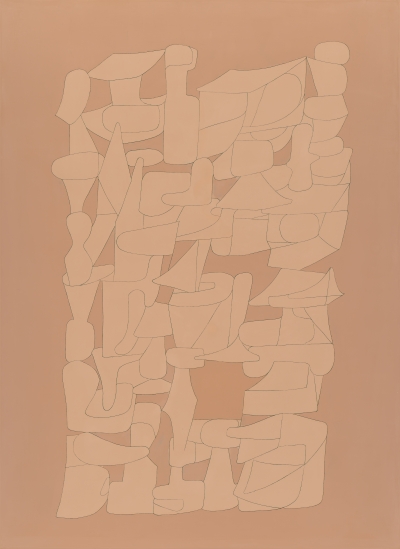
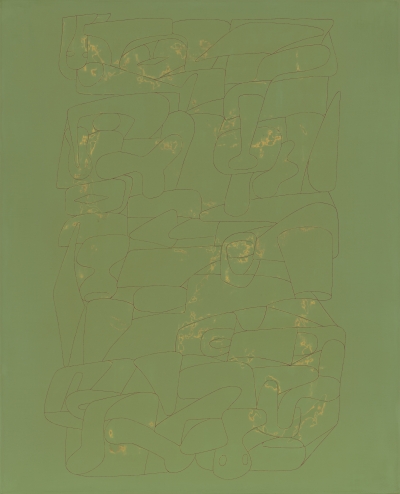
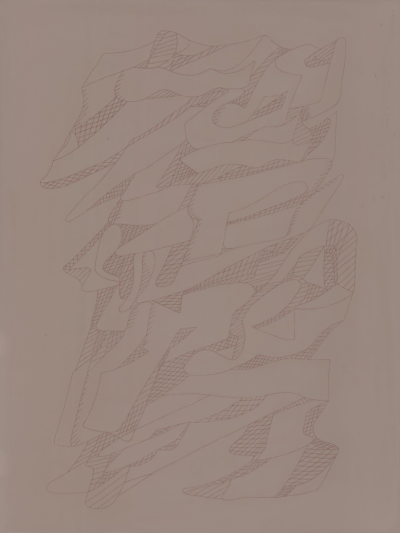
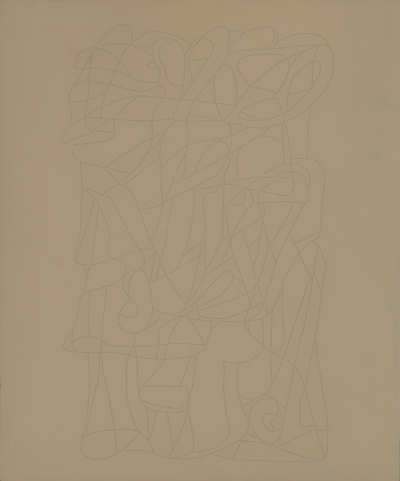
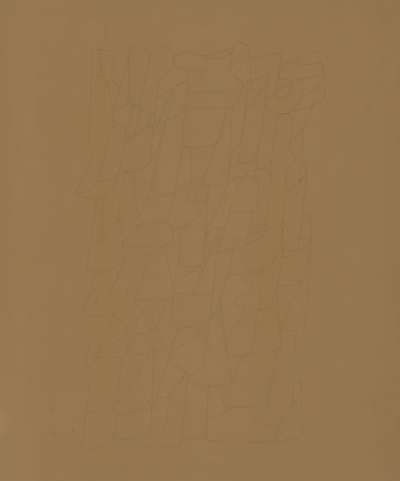
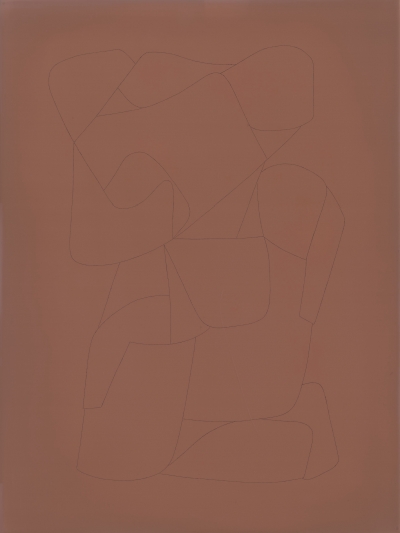
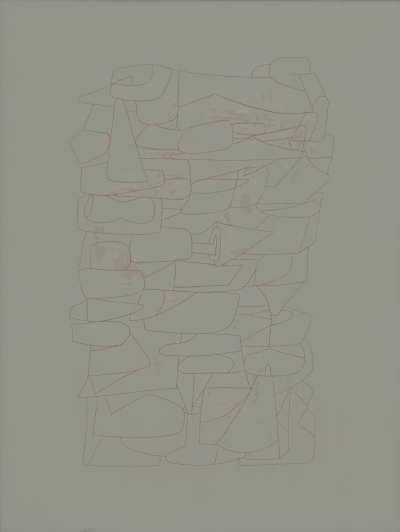
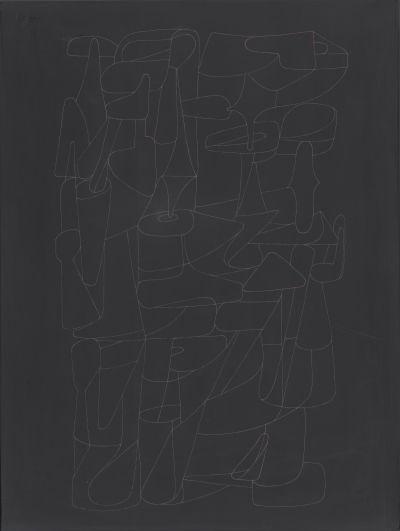
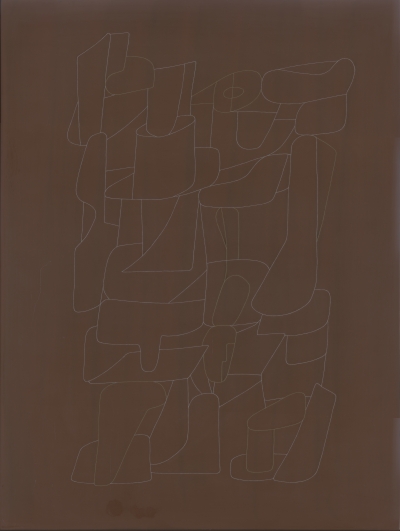
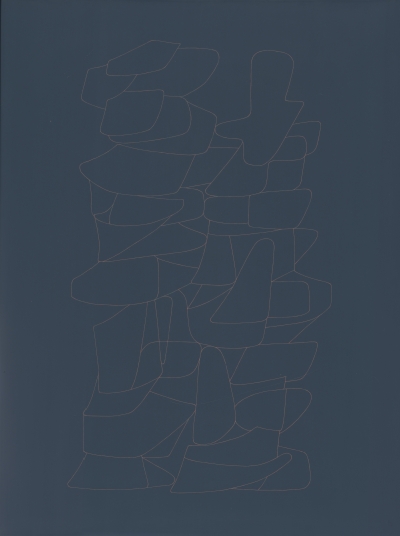
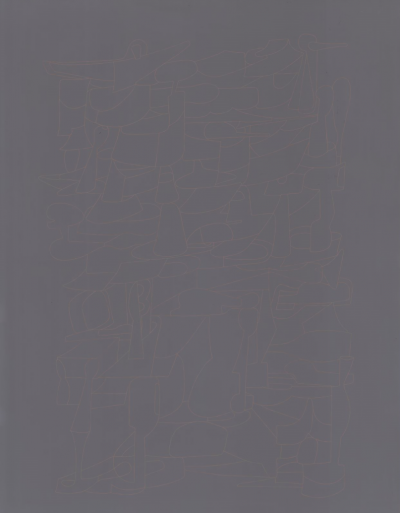
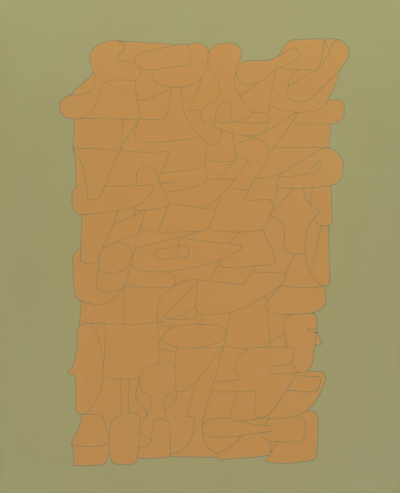
Lines are Wu Shan's way of understanding and disenchanting the world in his mode of observation. In the silk-like lines, we can’t seem to feel the artist’s intention. These lines flow without purpose, speed, or pattern, forcing the viewer to get close enough to see their trends. Therefore, his abstract schemas do not make people feel dizzy, dislocated, sublime and other classic aesthetic feelings, but provide the viewer with a calm and unobstructed viewing experience from a "prescribed" distance from the picture. These lines only begin to change in front of the viewers who can stop and stare, reaching a state of absolute condensedness, so as to show the spatial picture in which the viewers themselves do not exist. The space divided by lines seems to be the "gift" of the picture form. They exist as the purposeless purposefulness of the artist's creation. In the process of shrinking, internalizing and closing, they generate the expansion of viewing angles, and presents the layering of viewing itself and the viewpoint placed outside.
Lines are also his "tools" for maintaining focus, and are also the result of "focusness" in his creation. Concentration of focusness constitutes the pictures formed by closed lines, forms and blocks are intertwined by lines and attached by time, and between the duree of time, the space is naturally revealed. These lines are so light, yet so "complex". Lightness refers to the calm, ancient, composed and hairspring-like brushstrokes of the lines; while the "complex" is reflected in the constantly changing perspective, the constantly transforming orientation, and the unity formed by the mutual extrusion, blending and reconciliation of the blocks. From a methodological point of view, it is indeed cubism, but Wu Shan does not only stay in cubism. Rather than classifying his works into a certain doctrine, it is rather the lines on the picture that spontaneously make the artist wander in that time of coexistence of passion and hesitation. There, he put serenity, elegance, restraint, and most importantly, the sense of security on every line, and in the subtle differences between lines, he slowly move towards the "future" and bid farewell to the "past". The long farewell is so light that it is difficult for the viewer to perceive what has changed. It is true that abstract art is dedicated to the prepared viewer, and while closing the picture schema with lines, he also further delimits the viewer's scope. Such an anti-propagation, anti-repetition approach is simply too unmodern. Therefore, the contradiction extends from the connotation and extension of the work, which is so modern and so pre-modern. He found his own and unique "modern" among these contradictions that are difficult to detect by ordinary people.
In the artist's early works, we can relate the visual illusion to the specific reference of the schemas formed by the sketches, which are like mountains and rivers, gardens, stele, and rivers. In recent years, in his creation of works, firstly, the coloring on paper was withdrawn, and the colorful colors attached to the body blocks were lost, and then the sense of volume gradually faded. Those fine lines representing light and shade sank into the volume itself and disappeared. The line drawing is becoming more and more refined, and the lines are becoming more and more pure, showing a kind of self-confidence and uprightness with twists and turns.
At the same time, the line itself is also changing. In the middle and early stages of creation, there were some sudden stops and sharp turns, which like penetrating the back of the paper in wrinkle method, but now the lines are less sharp, and the lines are leisurely in soft and gentle transitions. The richness of these lines is not only the diversity of shapes, but also the quality and content of the same line unfolding in unexpected variations. If there are levels of abstract schemas, his creations have gone through a process from formal abstraction to pure abstraction. Lines start from the edge of things, rise into the sky, and stick to the horizon of pure thinking. In this evolutionary process, the line eventually regressed to the line itself. This point can also be seen from the title of the work. Although "Sikuaiyu", "Chaoyuange", "Shangjingma" and "Yijiangfeng" are unclear to say how they related to the specific schema of the picture itself, they places the ideological background between the lingering and gentle, soft and distant tension of Kunqu Opera.
From paper to lacquer, it is an upgrade of the artist's mature control of medium, texture and line in his middle age. The classicism, warmth and serenity contained in the lacquer are inseparable from its slow production process and unique material charm. The "light" in the lines and the "slow" in the lacquer meet unexpectedly in his creations. The decoration and elegance of lacquer, the inflexible aesthetic, the brisk and rhythmic line drawing form a contradictory yet unified aesthetic picture.The sinuous line drawing gradually peels off the worldliness brought by the decorative sense of the lacquer, leaving only the pure ancient charm that fits the line, making the line more hidden and more spiritual. In the traditional lacquer production process, in case of uncertainty of natural factors such as temperature and humidity, it is often remade to correct these unexpected pictures, but Wu Shan will keep these "accidents". If the line drawing is the accumulation of experience, mood and years, before the closed schema is completed, it represents a predictable uncertainty, then after the uncertainty of natural factors is layered, the plasticity of time and space is mixed, so that it has a unique cultural core and is separated from the aesthetic inertia of traditional lacquer.
So far, the line in his brush no longer resembles objects, because it refer to all things; it no longer attach to space, because of it, space can be unmasked; no longer rely on color, it infiltrates, merges, and fuses with lacquer. Lines are both form and content in his brush, and to understand the deep meaning, one must open the "cover" of color and read it carefully. The unity of opposites that remains in his creations is not intentional, but his creative techniques and observation methods place the contradictions at the source of his thoughts, and bring multiple dualities to the surface of the paper.
Ji Ran